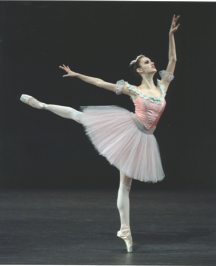
 Photo by Paul Kolnik
 Raymonda is one of those ballets that people love to call “a confection.” To all appearances it is as girly as ballet gets: we corps and soloist dancers sport Pepto-Bismol pink tutus with garlands in our hair, while the principal couple dons turquoise blue satin. Glazunov’s melodies lilt and repeat themselves often, and the music is even and predictable and lovely. However, all this twee fluff camouflages the fact that it is one of the most technically demanding ballets in our repertory. And at the end of day two of rehearsals, it wasn’t getting any easier. As is par for the course in Raymonda, several girls ended their solos sprawled on the floor.
I have always thought that Balanchine was being rather tongue-in-cheek with this ballet, but the more I dance it and watch it, the more I think it is downright hilarious! It begins with a long and dramatic overture before the music trickles almost to a stop and the curtain rises upon a stage of
I have always thought that Balanchine was being rather tongue-in-cheek with this ballet, but the more I dance it and watch it, the more I think it is downright hilarious! It begins with a long and dramatic overture before the music trickles almost to a stop and the curtain rises upon a stage of
twelve women who resemble a box of Magnolia cupcakes. These pretty little flower girls go on to dance a series of technically treacherous solos. The solos are all based on Petipa’s 1898 full-length Raymonda in which Balanchine had performed as a child at the Maryinsky, but Balanchine tweaks them in a comical way.
Let’s take the first variation as an example. It begins almost identically to the Petipa version with relevés in arabesque to both sides, but Balanchine goes his own way after that. Unusually, he has the dancer perform almost the whole solo on a dime. To dance this solo is to bring the stereotypical, plastic ballerina figurine affixed to the center of a music box to life—particularly in the David H. Koch Theater that architect Philip Johnson intended to resemble just such a jewelry box. The music is precious and twinkly like a music box theme too. Really, the whole thing could be a sly little joke about ballet stereotypes. However, after a bunch of off-balance piqués in a box pattern—the one neoclassical accent in this solo—Balanchine has the woman run to the corner and cross the entire stage diagonally in a series of 32 hops on pointe in arabesque. Hops on pointe are a signature of most classical solos, but there is no Petipa solo in which so many are used in a row. It’s as if Balanchine was proving that his own dancers could do classical steps as well as the purists, if not better. I think he was also showing how silly some of the most technical steps look when done in isolation—his commentary on the importance of choreography over technical tricks, perhaps?
Rosemary Dunleavy has been coaching us to take our Raymonda rehearsals as an opportunity to hone our technique. She said Balanchine made this ballet to show off his skilled dancers. From what Rosemary tells us, it sounds like Balanchine tried to put everything plus the kitchen sink into this ballet. She said that when Balanchine choreographed the first coda entrance in Raymonda--which begins with nonstop leaping passes for ten women before two soloists bound in for a dreaded fouetté turn dance-off—he wanted the ten women to run to the back and do fast échappés and pirouettes for sixteen counts, but they were all so tired from the jumping entrance that they kept falling over. He changed the choreography to sixteen counts of standing in b-plus—a position which is basically a ballerina kickstand—so they could recover their breath (a necessary break, I can attest)!
Even the ballet’s finale is goofy. While the corps chugs around in b-plus with port de bras that evokes the tossing of imaginary bouquets of pansies, the ballerina runs from the back of the stage and dives straight towards the audience like a torpedo. Her partner catches her at the very last minute to prevent her from landing in the orchestra pit, and she remains frozen in flight as a blackout brings the ballet to a close. To me this ending says: “we’ve done all we could here on the stage, now you get to take us home!” Especially as performed by Ashley Bouder, who catapults herself into the dark ether of the house without a shred of fear, this move can make audiences feel like they’re wearing 3D glasses.
Ms. Bouder perfectly exemplifies the winking glee of Raymonda; but that’s probably because she’s so technically assured that she can laugh along with it! (It’s a ballet that gives lots of people diarrhea.) I find that many of Balanchine’s uber-classical ballets are comically inclined: the sly wit of Divertimento No. 15 and the peasant humor of Donizetti Variations come to mind. But Raymonda is probably the funniest—or at least it seems so this time around…perhaps this is a mental coping mechanism to get me through rehearsals!
Let’s take the first variation as an example. It begins almost identically to the Petipa version with relevés in arabesque to both sides, but Balanchine goes his own way after that. Unusually, he has the dancer perform almost the whole solo on a dime. To dance this solo is to bring the stereotypical, plastic ballerina figurine affixed to the center of a music box to life—particularly in the David H. Koch Theater that architect Philip Johnson intended to resemble just such a jewelry box. The music is precious and twinkly like a music box theme too. Really, the whole thing could be a sly little joke about ballet stereotypes. However, after a bunch of off-balance piqués in a box pattern—the one neoclassical accent in this solo—Balanchine has the woman run to the corner and cross the entire stage diagonally in a series of 32 hops on pointe in arabesque. Hops on pointe are a signature of most classical solos, but there is no Petipa solo in which so many are used in a row. It’s as if Balanchine was proving that his own dancers could do classical steps as well as the purists, if not better. I think he was also showing how silly some of the most technical steps look when done in isolation—his commentary on the importance of choreography over technical tricks, perhaps?
Rosemary Dunleavy has been coaching us to take our Raymonda rehearsals as an opportunity to hone our technique. She said Balanchine made this ballet to show off his skilled dancers. From what Rosemary tells us, it sounds like Balanchine tried to put everything plus the kitchen sink into this ballet. She said that when Balanchine choreographed the first coda entrance in Raymonda--which begins with nonstop leaping passes for ten women before two soloists bound in for a dreaded fouetté turn dance-off—he wanted the ten women to run to the back and do fast échappés and pirouettes for sixteen counts, but they were all so tired from the jumping entrance that they kept falling over. He changed the choreography to sixteen counts of standing in b-plus—a position which is basically a ballerina kickstand—so they could recover their breath (a necessary break, I can attest)!
Even the ballet’s finale is goofy. While the corps chugs around in b-plus with port de bras that evokes the tossing of imaginary bouquets of pansies, the ballerina runs from the back of the stage and dives straight towards the audience like a torpedo. Her partner catches her at the very last minute to prevent her from landing in the orchestra pit, and she remains frozen in flight as a blackout brings the ballet to a close. To me this ending says: “we’ve done all we could here on the stage, now you get to take us home!” Especially as performed by Ashley Bouder, who catapults herself into the dark ether of the house without a shred of fear, this move can make audiences feel like they’re wearing 3D glasses.
Ms. Bouder perfectly exemplifies the winking glee of Raymonda; but that’s probably because she’s so technically assured that she can laugh along with it! (It’s a ballet that gives lots of people diarrhea.) I find that many of Balanchine’s uber-classical ballets are comically inclined: the sly wit of Divertimento No. 15 and the peasant humor of Donizetti Variations come to mind. But Raymonda is probably the funniest—or at least it seems so this time around…perhaps this is a mental coping mechanism to get me through rehearsals!
 RSS Feed