Thoughts from the paint
  • Thoughts
  • About
  • Bio
    • My Bio
    • Guest Bios
  • Contact

Season Kickoffs and Free Agents

9/20/2016

0 Comments

 
Picture
Baby Craig and me, photo by Rosalie O'Connor
Picture
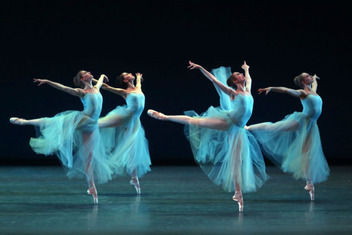
Gwyneth in Serenade
Fall is my favorite time of the year. I am thrilled that the temperature is leveling off and the mums and squashes have begun to appear on the neighborhood stoops. It is always an invigorating time in New York, as it is the start of so many cultural seasons. Mercifully for me, it also marks the start of football season, which has been a necessary distraction as I eagerly await the birth of my baby who is now past due! Perhaps he or she will come on the autumnal equinox?

Though dance and football have not been sympatico so far this season (my beloved Antonio Brown was fined in the very first game for this​ end zone dance, which I may borrow as a labor position…), they have been foremost in my mind lately. For today is also the kickoff of the NYCB fall season, and I have been thinking of my colleagues. Tonight’s gala showcases four new ballets, two of which are by female choreographers—hallelujah! NYCB Principal Lauren Lovette and guest Annabelle Lopez Ochoa are the debuting duo. There is also a new offering from resident choreographer Justin Peck and one from the young corps member Peter Walker, who is an excellent partner and a genuinely nice guy. I wish them all the best of luck this evening.

But as the season begins I want to acknowledge a slew of retirements that happened at the end of the summer. Three lovely young women, Dana Jacobson, Lara Tong, and Stephanie Chrosniak, have moved on to other pursuits. I have no doubt they will find success in their next endeavors. Senior corps men Joshua Thew and David Prottas have also left the company. Josh, who is an amazing singer, is going to devote more time to this other skill as well as model. David is joining the touring company of An American in Paris. I danced my last show before maternity leave with David, he has been a wonderful partner over the years. They will all be missed.

Especially transformational for the company is the loss of two dancers who had been around for almost two decades: Craig Hall and Gwyneth Muller. I attended their final performances on back to back evenings in Saratoga Springs this summer, and it was such a moving experience. Craig wrapped up his performing tenure with the Concerto section of Balanchine’s Episodes. His handsome calmness and phenomenal partnering skills were on fine display. I liked that he went out in a quirky part too, for Craig is also a total goofball and the role’s swings between seriousness and playfulness suited him perfectly.

Gwyneth danced her last Serenade the following night. There is no more fitting retirement vehicle than Serenade, Balanchine’s masterpiece of life, death, and rebirth. Gwyneth, who has never given less than one hundred percent of her energy onstage, looked especially radiant in her final evening of swooshing blue tulle. Her last incarnation as the “mother” figure in the elegy section was intensely emotional.

These incredible artists have been my close friends since our early days at the School of American Ballet, and their professionalism and positivity have made them pillars of the NYCB community. Craig, with whom I have a lifelong bond from our intense early experience of dancing in Chris Wheeldon’s Scènes de Ballet, is staying with the company as a ballet master.  Gwyneth, who has been a dear friend of mine through high school, undergrad, and ballet life, just kicked off her first semester at Yale in a prestigious arts administration program. I am sure that Craig and Gwyneth will be as prosperous in their new roles as they were in their dancing careers and I am so very proud of them.   
     
Picture
Gwyneth, photo by Erin Baiano
Picture
Craig, photo by Matthew Karas
0 Comments

Cats on Broadway

9/1/2016

0 Comments

 
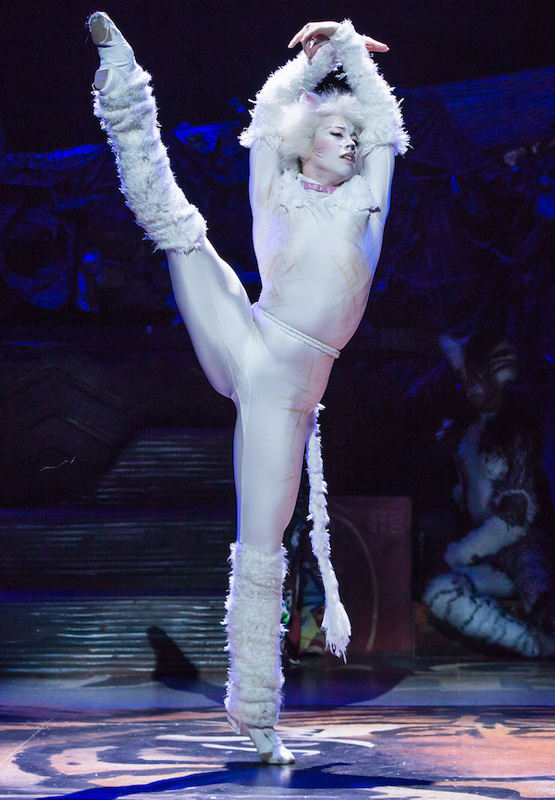
PictureGina Pazcoguin, photo by Matt Murphy
Cat person that I am, I had never seen Andrew Lloyd Webber’s musical Cats until this week. I have long been familiar with T.S. Eliot’s poems on which the show is based, and I knew some of the songs (“Memory,” bien sûr), but other than that I was a total newbie. My friend and NYCB colleague Georgina Pazcoguin stars as Victoria the white cat in the current Broadway revival, and it was wonderful to see her shine—glow, actually—in a new milieu.

Cats and ballet make for good bedfellows, even outside of the pas de chat or “step of the cat.” George Balanchine is famous for his obsession with his cat Mourka’s leaps. And NYCB ballet mistress Rosemary Dunleavy is always reminding us to place our feet nimbly like cats, to work exaggeratedly through demi-pointe when we roll through our feet. She also encourages us to study our cats at home when she coaches the crawling around in the Arabian solo in The Nutcracker—and  she often does this while wearing the iconic Cats on Broadway t-shirt for good measure! Perhaps this is why Gina looked as comfortable in the junkyard set as she does in her tutus.

I found the show to be quite a hoot, which is not shocking given its jocular source material, but that aspect surprised me nonetheless. It is basically a jukebox musical of cat puns—there is not much in the way of plot or character development. In fact, the few through-lines the show has are its weakest links: Grizabella’s mysterious outsider status and fall from grace are relatively unexplained, making her reincarnation at the end feel hollow. I also wasn’t convinced by Leona Lewis’s portrayal of an old kitty. I know she is the headlining star in the show, but she looked like she was play-acting. Wouldn’t a respected Broadway elder have been a better fit? And the evil Macavity’s arrival is hyped often, yet the event itself underwhelms. He doesn’t even get a song. His catfight sequence seemed really weak after the foreshadowing number by the silky duo Madison Mitchell and Christine Cornish Smith as Demeter and Bombalurina.   

What was such great fun about the show was the sheer silliness of it, from the cats entering through the dark audience with glowing eyes in the opening, to the grooming orgies, and the oddly poised group recitations of Eliot’s goofy verse. And the show is jam-packed with impressive dancing. Almost all of the cast sings and dances the whole time—and they are clearly an extraordinarily talented ensemble. Gina, whose albino unitard makes her stand out in even the darkest scenes, was in constant motion for over two hours. She danced beautifully and her committed performance alone is (in my admittedly biased opinion) worth the price of a ticket!

Since I am unfamiliar with the original choreography, I cannot comment too much on Andy Blankenbeuhler’s updates, but there were definitely some hip-hop accents that resembled his work in Hamilton. He also loves a slow, partnered lean-out arabesque. The dancing was really great throughout, and I couldn’t believe how well the performers were able to sing and enunciate while lifting each other, turning, and cartwheeling. Ricky Ubeda, as Mistoffelees, has the tour-de-force dance number of the production and he sailed through it. It contained a gauntlet of tricks: à la seconde pirouettes, coupés tombés jetés en tournant, etc. It reminded me of a Youth America Grand Prix solo, but with singing and a Siegfried and Roy light-up coat!

Since I’m having frequent Braxton-Hicks contractions and back pain now, it was hard to sit comfortably, and the show felt overlong to me. But I think even if I wasn’t extremely pregnant a little editing would have gone a long way. Also, how can you revive a cat musical in 2016 without a single nod to the internet? There was no cat-breading or cat-sushi-ing, no cat-Nicholas Cages or Hello Kitties, etc., to be found. When one cat took a ride on a broom I wished it was on a Roomba. This Cats revival is a little too serious for its own good, it is begging for some sort of meta-nod to modern cat memes.

Also, I’ve always had cats in my life, and cats are never that earnest. While Eliot’s poetry aptly describes many kinds of cats, (for example: my parents’ fat cat Giles was personified to a tee by Christopher Gurr as Bustopher Jones) I needed a little more cynicism to see the show as a proper feline tribute. The Cats cats perfectly embodied Eliot’s cat poems, yet for me to be convinced I needed to believe that they’d rather be contemplating his Four Quartets.   

Last week I watched Stranger Things on Netflix, this week I saw Cats on Broadway with a group of friends I’ve known since I was a kid. The 80’s are having quite the renaissance. It is so surreal, on the cusp of motherhood, to be inundated with imagery from my own childhood! 

Picture
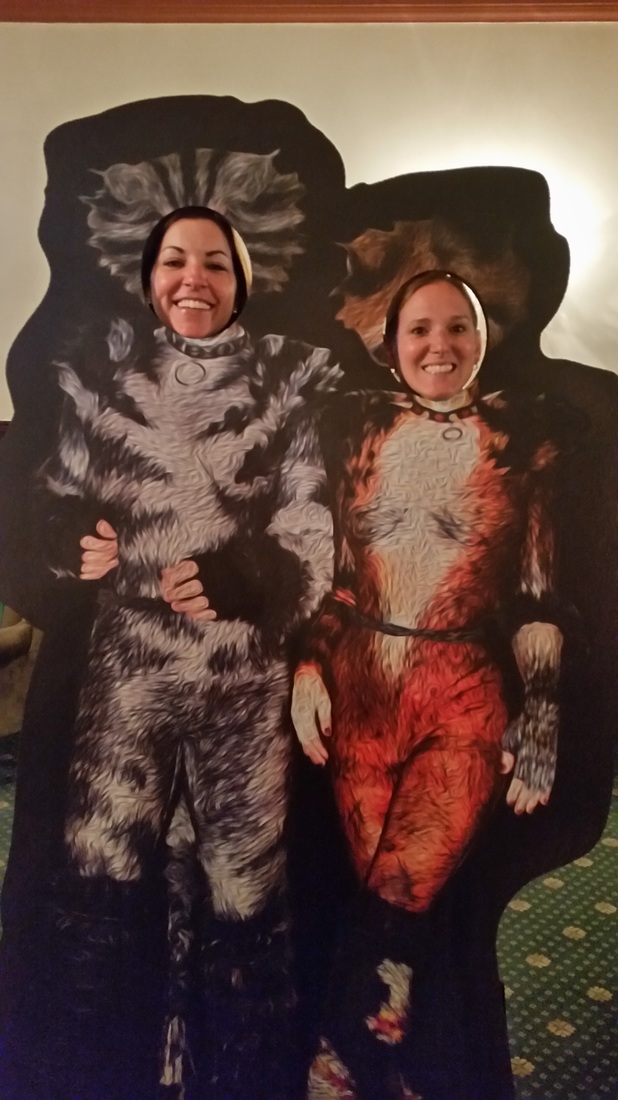
Michelle and Elaine get catty in the lobby
Picture
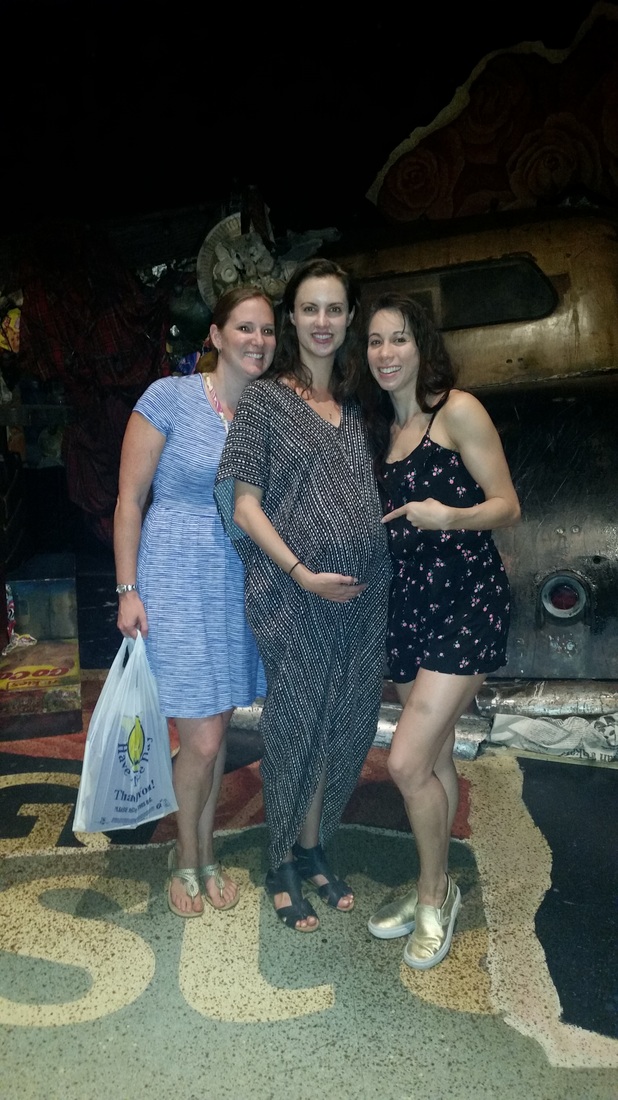
Elaine, me, and Gina backstage
0 Comments

Golden Cockerels

6/10/2016

0 Comments

 
Picture
Picture
Picture
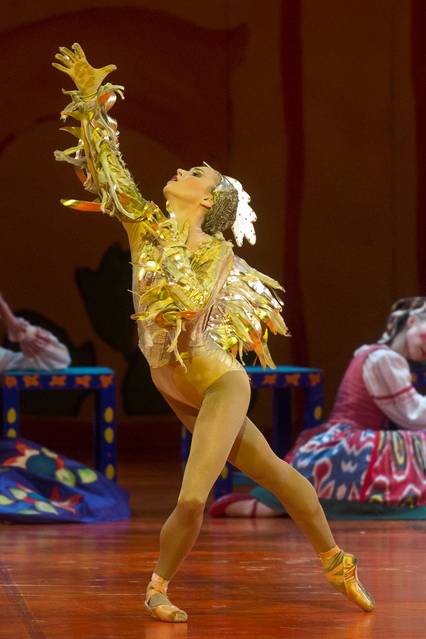
Skylar Brandt, left, as the Golden Cockerel vs Beyonce

​Thanks to a tardy diva, this week I saw Beyoncé’s Formation Tour at Citi Field and ABT’s new production of The Golden Cockerel at the Met Opera House within a fourteen hour time span. Who knew the leads in both productions would be sporting the same look? Who wore it better? Queen Bey, bien sûr.

After waiting around for hours for Beyonce’s set to begin on Tuesday night, there was no way I was going to be stuck sitting in my seat early for the Wednesday matinee. Alas, I overestimated the MTA, which was running as late as the diva during an afternoon thunderstorm, and I didn’t have any time to read the ballet’s synopsis before it began. Boy was I lost! The Golden Cockerel has a convoluted history as a politically banished opera (1909) and a one-act ballet (1914), with a literary provenance involving Pushkin (1834) rewriting Washington Irving (1832). This all sounded intriguing to me, unfortunately the results were not. ABT’s new production is a revival of Alexei Ratmansky’s 2012 resurrection of the piece for the Royal Danish Ballet. The original ballet for the Ballet Russe de Monte Carlo (which was Fokine’s last choreographic effort) was a one act, 45 minute affair. Ratmansky chose to flesh out the ballet using more of the score from Rimsky-Korsakov's 1909 opera so that it became a full-length vehicle, which was a problem.

The lavish sets and costumes, by Richard Hudson after Natalia Goncharova’s Ballet Russe designs, were wonderful: folksy, vivid, whimsical. But great sets and costumes alone are not enough to make a great ballet; they can make for a great fashion show, sure, but those usually last around 15 minutes tops. The ballet had enough set changes, giant puppets, swirling skirts, and elaborate scrims to fuel a 45 minute piece, certainly, but not more. I will not attempt to summarize the plot here, because I’m still a little confused even though I have the program open in front of me now. Also, it was so dumb I couldn’t really care. But I was baffled at intermission when I finally got to check out the program and realized that the man galumphing around in the grey wizard beard was James Whiteside. I thought he was supposed to be the male dancing lead? He must change into ballet shoes for the second act, I assumed. No such luck. Although James looked like he was enjoying the chance to play against type, this bit of casting did nothing for me.

Hee Seo danced the lead role of the seductress Queen Shemakhan with her usual loveliness. Her beautiful, melting port de bras was appropriately erotic but her character made absolutely no sense and was more of a placeholder. That was too bad, because I have seen her excel in Ratmanksy pieces before—particularly Seven Sonatas--and their pairing was one of the reasons I chose to see this production. Perhaps, since Ratmanksy went to the trouble of lengthening a thin premise anyway, her motives and storyline could have been elaborated to better effect.

As it was, the story revolved mainly around the doddering Tsar Dodon—a character role inhabited well enough by Roman Zhurbin—and his foibles as a ruler. His princely sons got the most dancing in the production and were therefore the highlight of the show, even though they died in battle at the beginning of the second act. Arron Scott and Alexandre Hammoudi danced these roles well, and their solos had some interesting circus-like aspects to them (like splits and cartwheels) that fit nicely into the cartoonish vibe of the production.

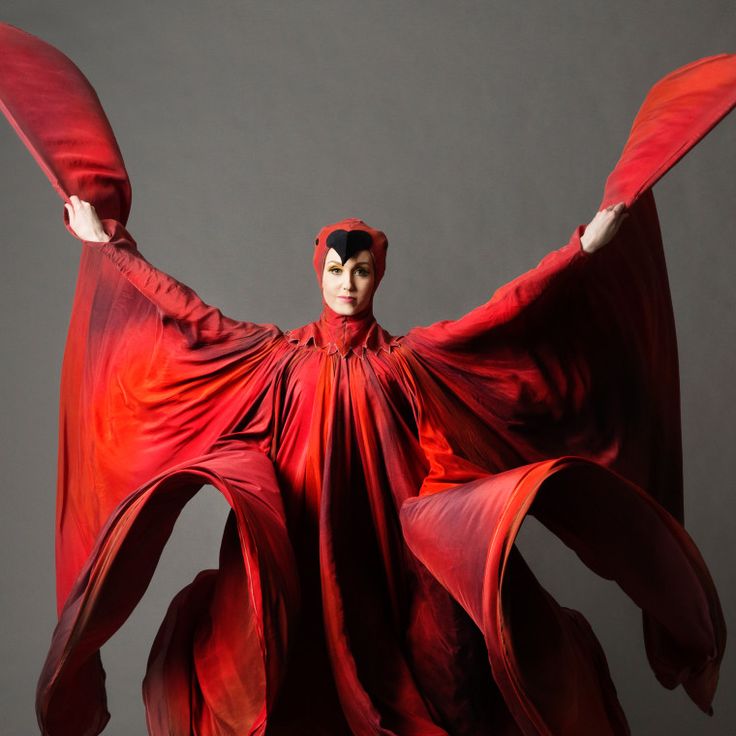
And what of the title role? Sarah Lane’s Golden Cockerel was technically strong and engaging, but the part felt too much like a cameo appearance. Her first entrance with James Whiteside in the Tsar’s palace was the most choreographically innovative section of the ballet and I had high hopes. She performed prickly bent leg toe-hops, and I liked how she repeatedly folded to a kneeling position on the floor like a mechanical doll. But that was basically her whole gig. Even as my mind wandered during the second act (I haven’t been that bored at the ballet in a long while) from which she was largely absent, I was excited for her to peck the Tsar to death in the finale. I thought that would be so cool, a sort of feminist vindication for all of the tragic-avian heroines in the history of ballet: Odette and her coterie, the Firebird, the Nightingale.

Sadly, in the brief, murderous scene, Lane was shuttled around by two men in cumbersome black cloaks (the dead princes doing double duty—maybe black or gold unitards would have been subtler?) so she could perch and peck on the Tsar’s shoulders for a second before being carried offstage. What a letdown—so much for ladybird empowerment! In general, there were far too many females being wheelbarrowed around the stage by two men in this production. Hee Seo and Sarah Lane were repeatedly dragged around by Zhurbin and Whiteside, or Scott and Hammoudi. In Act II Devon Teuscher was also shoveled along by Calvin Royal III and Jose Sebastien in a weird bit that felt tacked on. They seemed like they were there just to showcase very long, Pierrot-like sleeves.

At the end, the James Whiteside character explained—much like Puck in his “If we shadows have offended” passage at the end of A Midsummer Night’s Dream (both the play and the Balanchine ballet)—that the whole thing had been made up. He walked past clock-like, tic-toc motion vignettes of the main characters in the story to prove his point. There was Craig Salstein as some sort of henchman, Tatiana Ratmansky as a busybody housekeeper, the long-sleeved trio, and the two princes stabbing each other in the stomach back and forth. Wait, what? Did they kill each other? The program said they died defending their father’s kingdom in battle. If they had a Cain and Abel backstory going on I’d definitely have been more interested in that!

The Golden Cockerel made me understand anew why Balanchine pared down so many of the old story ballets into dance-heavy one-acts: like his Swan Lake, and especially, his sumptuous, Chagall-designed Firebird (with which The Golden Cockerel shared many similarities, and which dates from roughly the same era). It was a shame that ABT spent so much money on the production, for the audience buzz was not favorable during intermission or afterwards. “Where was the dancing?” people kept asking. “What was going on?” was the main query on the bathroom line. At least it took me only half an hour to get home, instead of the two-hour odyssey I had back from Queens the night before! More on that experience next time…     
0 Comments

Ben Lerner Essay/ A Personal Announcement

5/19/2016

1 Comment

 
Picture
Russell Janzen and I recently went to hear Ben Lerner read at the New School. Russell turned me on to Lerner’s writing a few years ago, and since then I have become a little obsessed.  I loved his novels Leaving the Atocha Station and 10:04, but I was quite surprised when I read an excerpt from his new essay “The Hatred of Poetry” in the April edition of Poetry Magazine (to be published in its entirety on June 7th) and found myself analogizing several of his thoughts on the stigmatization of poetry to the ballet world. Lerner writes in the excerpted essay that, “some kids take piano lessons, some kids study tap dance, but we don’t say every kid is a pianist or dancer.” I have to disagree with Lerner here. For at least in the latter case, people most certainly do!

“If you are an adult foolish enough to tell another adult that you are (still!) a poet, they will often describe to you their falling away from poetry:
I wrote it in high school, I dabbled in college. They will tell you they have a niece or nephew who writes poetry….There is embarrassment for the poet—couldn’t you get a real job and put your childish ways behind you?” Lerner writes.  I laughed as I read these lines, for if you switch out poetry for dance it becomes a conversation that most professional dancers have frequently.

Often, when I explain that I am a ballet dancer people will say “oh yes, I did that” or “my daughter is a dancer too.” In reality, they took dance when they were five and their daughters are fourteen and on cheerleading squads or in competitions—which is great, but it is not quite the same as performing seven shows a week for years! Sometimes people ask me what my day job is, or what I will do next. There is little consideration that ballet dancing could be a real occupation. Though of course, they are correct in that one cannot practice ballet forever, as one could potentially write poetry well into old age. But still, their dismissal ignores the fact that dance could be a multiple-decades long, quite serious (if not very lucrative) endeavor.

Lerner continues: “when you are foolish enough to identify yourself as a poet your interlocutor will often ask you to name your favorite poets. When you say, “Cyrus Console” he squints as if searching his memory and nods as if he can almost recall the work and the name, even though of course he can’t (none of the hundreds of non-poet acquaintances who have asked you this sort of question ever can).” This passage also resonates, for unless I respond with Baryshnikov or Nureyev I will get a blank stare. Perhaps current ABT principal Misty Copeland is becoming one such household name, but the truth is that the general public is not well educated on trends in the field. Obviously if you follow this obscure blog you are not the random airplane seatmate, for example,  to whom I am referring!

If I can make it clear that I am a dancer, and that it is my sole source of income and it is indeed a full-time job, they will become skeptical again when I reply to further inquiry that my favorite ballet is not
Swan Lake but Serenade or Concerto Barocco. Naturally they have never heard of it, and then they think I must be in some amateur troupe. (Balanchine and neo-classicism are not in common parlance outside of New York.) There is nothing wrong with that, in the same way that I enjoy poetry, read it sometimes, and had no idea who Cyrus Console was either. But I was not surprised that a working poet did not respond with Keats.

It is wonderful that so many people take ballet classes in childhood, yet I find it unfortunate that their conception of an entire art form is frequently crystallized in that fledgling experience. I also believe that people intuitively respond to movement and can find aesthetic pleasure in it, but somehow that appreciation is not widely cultivated in our society. I was taught the difference between Impressionism and Mannerism in public elementary school, but there was not much in the way of dance education.  Dance fandom becomes a study in esoterica if that passion survives into adulthood. 
             
At the reading, Lerner did not select an excerpt from his new essay but instead chose one from
10:04, perhaps because he is far more famous for being a novelist than for being a poet. But during the Q&A session afterwards he spoke about how he will always describe himself as a poet, because he feels that it is who he truly is, even if he is now known for something else. He spoke of poetry the way dancers speak of dancing—like it is a calling or an identity rather than a hobby or a livelihood.

I have been thinking a lot about this lately because I am pregnant. I am so incredibly excited about my new role as a mother, but it is funny to feel utterly divorced from my dancing life as my body changes and my waistline expands.  Unlike some dancers—notably NYCB principal Ashley Bouder, who was able to take ballet class in pointe shoes past her due date!—I was forced to stop dancing before the end of my first trimester. My baby and I danced through some hectic weeks of
Nutcracker, but by the time the Winter Season began I became so nauseous ("morning" sickness can apparently be a 24 hour affair) and exhausted that it was impossible to keep up a healthy gestational weight. Ballet dancing in peak physical form is hard work, ballet dancing on an empty stomach is nearly impossible. My doctor—and my instinct—told me it was necessary to bow out and take it easy.

The pregnancy books recommend that women disclose their pregnancies to their employers at four or five months along. Ha, as if that could be possible for a dancer! Even the indomitable Ashley could not perform too far into her second trimester, and there was definitely no hiding the fact that she was pregnant much earlier than that. Since I had to stop dancing before I wanted to announce my pregnancy to the company and the public, I was in a tough situation. Luckily ballet mistress Rosemary Dunleavy helped me to drop out quietly midway through the season. I am forever grateful to her for being so understanding and supportive. I was sorry that my little one did not get to be a part of such moving, iconic works as
The Four Temperaments and Tchaikovsky Piano Concerto #2, but clearly he or she—my partner and I have decided to leave it a surprise—wanted no part in dancing!

Tricky logistics and a lousy first trimester aside, the experience of being pregnant has been absolutely fascinating to me. I am sure most mothers feel that way, but I think for dancers—who are so attuned to their bodies—it is a time of particularly heightened sensations. I knew right away that I was pregnant, before a urine test would work, because my body felt immediately different. Even while I was able to perform through my first few months, everything felt wonky. My muscles were looser, my center of gravity was constantly shifting. My partner David Prottas kept asking me during
Symphony in C: “are you on your leg? I can’t tell.” Hehe, I couldn’t either. My pelvis seemed to be in a different place every day. My colleagues claim not to have noticed a difference in my appearance, but my tutus certainly fit differently. Even as I was losing pounds my breasts and abdomen were growing and I was loosening the hooks of stiff bodices.

Even more bizarre was the inability to control my own eating habits. As a dancer, I must consciously plan my meals around maximizing nutritional energy. By my third month of pregnancy, I could not stand the sight of meat. I was having all sorts of odd cravings and (mostly) aversions; it was so hard to ensure that I was getting enough protein. I found it incredible that something the size of a blueberry could dictate so many aspects of my life. Now that I am further along I am loving the feeling of the baby dancing around on its own all day, and all through the night!   

It seems that there are as many different pregnancy experiences as there are pregnant bodies. I know that Ashley, as well as new NYCB mothers Maria Kowroski and Abi Stafford, had very little morning sickness throughout their pregnancies. Some dancers have come back from childbirth very quickly, for others it takes much longer. Many women have told me that the experience was radically different with each child they had. The first lesson in motherhood seems to be that you cannot control everything, and it is a humbling one.

I am doing more reviewing on this blog now that I am not performing, as many of you have noticed. Thank you to everyone who has inquired about my absence! For now I am taking it day by day and listening to my body, which is essentially what I do when I am dancing anyway. So maybe these identities—mother, dancer—are not so incongruous after all.
1 Comment

Miami City Ballet

4/25/2016

0 Comments

 
Picture
Heatscape, photo by Gene Schiavone
I wasn’t planning on writing about the Miami City Ballet performance that I saw last week, but I kept thinking about it and decided that the dancers were too good to go unmentioned. I caught the second program the troupe offered during their weeklong run at the Koch Theater, and all three pieces—including a vintage Balanchine ballet—were new to me.

The evening commenced with
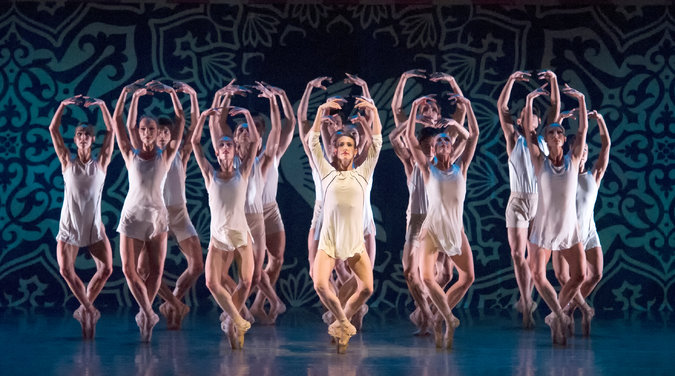
Heatscape by Justin Peck to a piano concerto by Bohuslav Martinu. I liked it. It was energetic—even the slow second movement contained frantic tosses and partnering which ran over the adagio melody—and the Miamians know from energy! The ballet was set before a big Shepard Fairey backdrop which, curiously, reminded me of a biker bandana. The lovely white shift dresses for the women and grayish shorts for the men were designed by Reid Bartelme and Harriet Jung—I thought Tricia Alberton’s long-sleeved version with black piping was especially pretty. Jeanette Delgado danced her thorny solo passages with real flair. Like her sister Patricia, Jeannette has an easy-going, joy-of-dance quality in performance which is so infectious. My favorite moment in the ballet was when the corps joined Albertson in the second movement for slow hops en pointe in fifth position. It was a nice riff on the second movement of Balanchine’s Concerto Barocco.

Liam Scarlett’s
Viscera followed, and it suffered from having a similar structure to Heatscape. It was also set to a piano concerto (by Lowell Liebermann), it also featured a cast of 16, Jeannette Delgado was back in a tricky soloist role, and the corps ran in and out in noodle-y formations like in the Peck piece. The overall feel of Viscera was much darker, but that aspect conferred ponderousness instead of drama. The long central pas de deux looked rather like a rip-off of Christopher Wheeldon’s iconic Polyphonia at times, with its purple leotards, dark lighting (by John Hall), and upside-down swastika lifts. Scarlett—like Wheeldon—has some innovative partnering ideas, but this was not his best effort.

The evening’s finale was Balanchine’s infrequently performed
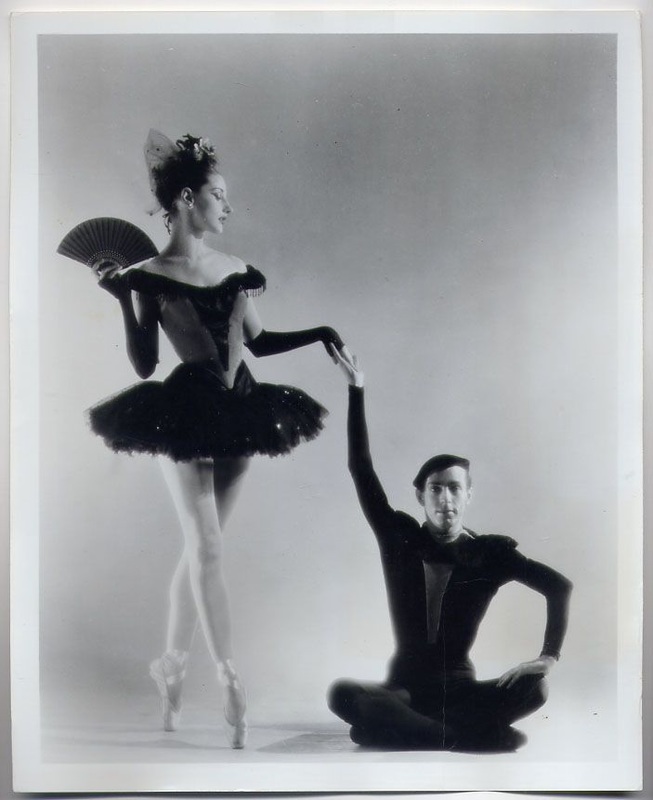
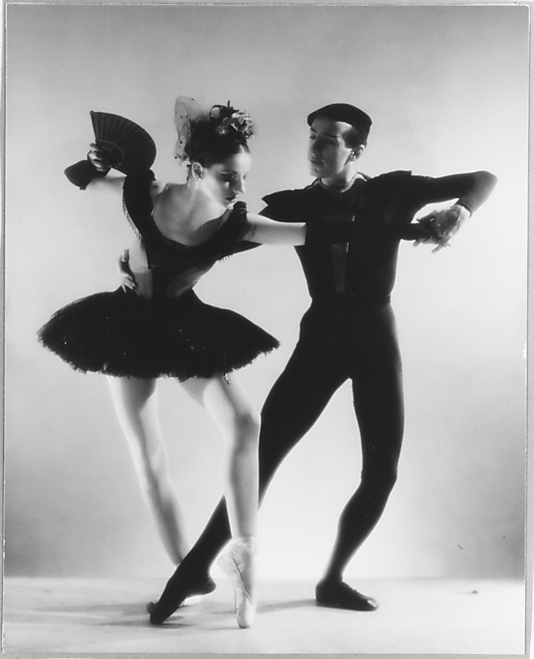
Bourrée Fantasque from 1949. I have always been curious about this ballet, since it is the source of the famous, glamorous photo of Tanaquil Le Clercq wielding a fan over Jerome Robbins perched on his rump. The music is by French composer Emmanuel Chabrier and the ballet reflects Balanchine’s years in Paris watching the can-can dancers at the Moulin Rouge. I can see why it has fallen out of NYCB’s repertory, for it resembles a mash-up of many of Balanchine’s other works: particularly Western Symphony (1954), Danses Concertantes (1972, after 1944), and the third movement of Brahms-Schoenberg Quartet (1966). But it was so thrilling to see a brand new (to me) Balanchine piece! And the gorgeous Karinska costumes! The witty tone and the complex geometries and musical counterpoints made by the corps de ballet were refreshing. The craftsmanship of the whole piece, which was staged for MCB by Suzy Pilarre, was excellent. Incredibly, even second-tier Balanchine is superior to the top-shelf works of many others.

The first movement was led by Jordan-Elizabeth Long and Shimon Ito in the roles created by Le Clercq and Robbins. Their pas de deux was a variation on a favorite Balanchine joke: the small guy/tall gal pairing. They were spot-on in their technique and their humor. The crisp precision of the corps was outstanding. And the short, sassy tutus worn by the women were adorable. The second movement, a lush adagio in romantic tutus, was well-danced by Simone Messmer and Rainer Krenstetter. It was so good to see Simone back onstage in NY!

The massive finale unfolded much like that of
Theme and Variations, with accumulating corps couples meeting on center and parting, followed by demi-soloists couples (Zoe Zien and Ashley Knox were back again, having changed out of their 1st movement costumes), and finally the cheery principles Nathalia Arja and Renato Penteado. But then the dancers from every movement returned for one of the biggest Balanchine finales I’ve ever seen. Tutus short and long were swirled about in kaleidoscopic patterns and the Koch’s massive stage was full to the brim. It felt a bit everything-but-the-kitchen-sink, but it was exhilarating.

​The Miami City Ballet dancers must be commended for their passionate dancing throughout the evening. The troupe is not as big as the NYCB, and both programs they brought to NY contained large-scale ballets. This meant that many dancers were doing double and triple duty: like the tirelessly committed Jeannette Delgado and Shimon Ito, and the scene-stealing Zoe Zien—who was featured in the first two ballets and popped up in two more movements in the closer. I hope these talented dancers got a good rest after their tour, they certainly earned it!  
    
Picture
Picture
Le Clercq and Robbins in Bourree Fantasque, photo by George Platt Lynes
0 Comments
<<Previous

    Author

    Faye Arthurs
    - Faye Arthurs

    Categories

    All
    ABT
    Albert Evans
    Alexei Ratmanksy
    A Midsummer Night's Dream
    An Introduction
    August Bournonville
    Benjamin Millepied
    Beyonce
    Broadway
    Carla Korbes
    Carnegie Hall
    Che Malambo
    Chopiniana
    Chris Wheeldon
    Concerto Barocco
    Craig Hall
    Crystal Pite
    Death Of Klinghoffer
    Devin Alberda
    Donizetti Variations
    Duo Concertant
    Firebird
    George Balanchine
    Georgina Pazcoguin
    Glass Pieces
    Goldberg Variations
    Gwyneth Muller
    Hamilton
    Harlequinade
    In The Night
    Janie Taylor
    Jared Angle
    Jerome Robbins
    Jewels
    Joshua Beamish
    Kaitlyn Gilliland
    Katy Perry
    LADP
    La Sonnambula
    La Sylphide
    La Valse
    Leanne Cope
    Le Baiser De La Fee
    Liebeslieder Walzer
    Lin-Manuel Miranda
    Maria Kowroski
    Mariinsky
    Mark Morris
    Martha Graham
    Martin Harvey
    Miami City Ballet
    Mick Jagger
    Moira Shearer
    Mozartiana
    Opus 19/The Dreamer
    Pictures At An Exhibition
    PNB
    Pontus Lidberg
    Raymonda
    Robbie Fairchild
    Russell Janzen
    Saratoga
    Sebastien Marcovici
    Serenade
    Swan Lake
    Symphony In C
    Symphony In Three Movements
    Teresa Reichlen
    The Four Temperaments
    The Nutcracker
    Tiler Peck
    Troy Schumacher
    Twyla Tharp
    Wendy Whelan
    William Forsythe
    Without

    Archives

    September 2016
    August 2016
    July 2016
    June 2016
    May 2016
    April 2016
    March 2016
    February 2016
    January 2016
    December 2015
    November 2015
    October 2015
    September 2015
    August 2015
    July 2015
    June 2015
    May 2015
    April 2015
    March 2015
    February 2015
    January 2015
    December 2014
    November 2014
    October 2014
    September 2014
    August 2014
    July 2014

    Related

    New York City Ballet
    Oberon's Grove
    BalletCollective

    Globe Dancer
    Kaitlyn Gilliland
    Bachtrack​

    RSS Feed

©2014 Faye Arthurs - Thoughts from the paint
Thoughts         About          Bio         Contact